

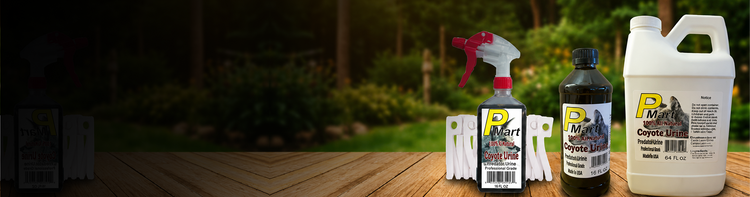
Predator Urine Spray for Natural Pest Control
Predator Urine Spray for Natural Pest Control
If nuisance animals are treating your yard like an all-you-can-eat buffet, you've probably already tried taste deterrents, motion lights, and physical barriers with limited results.
Predator urine spray works differently. It doesn't just inconvenience the animal at the point of contact. It intercepts the animal before it ever gets close by delivering the one signal prey animals are hardwired to take seriously: the scent of a predator that has already claimed the territory.
At The Pee Mart, we've spent close to 30 years supplying 100% genuine predator urine, and the spray format is one of the most precise and versatile tools in the lineup.
What Happens in a Prey Animal's Brain When It Smells Predator Urine
The reason predator urine works comes down to a neurological response that prey animals cannot override through familiarity or habituation, the way they do with most chemical repellents.
When a deer, rabbit, raccoon, or groundhog detects the scent of a natural predator, the brain flags it as a territorial signal. The animal does not investigate further. It reroutes.
This survival instinct has been reinforced over thousands of years of predator-prey interaction. Even without a physical predator present, the scent signature alone triggers a threat response and causes the animal to leave the area.
This is why authenticity matters. Diluted or synthetic urine lacks the full chemical profile needed to trigger the response. Genuine, undiluted predator urine carries the biological message prey animals are wired to recognize.
How Predator Urine Spray Reaches Animals Other Formats Miss

Spray is the most targeted delivery method in the predator urine lineup. While granules broadcast scent across wide open ground and P-Wicks hold scent on hanging dispensers along a perimeter, spray lets you put the scent exactly where you need it on vertical surfaces, structural contact points, and specific hotspots that other formats can't address as precisely.
You can apply it to:
● Fence posts and gate frames where animals test entry points before committing to crossing.
● The base of the garden border stakes at nose height for ground-level browsers like rabbits and groundhogs.
● Tree trunks and ornamental shrub stems in areas where deer have been marking or browsing.
● The exterior corners of sheds, coops, and outbuildings that raccoons and opossums probe for access.
● Specific trail entry points where you've identified worn paths or tracks in soft ground.
Each of those spots is a decision point where an animal is assessing whether to proceed. A targeted spray application at that exact location puts the threat signal right where the animal's nose goes first.
Shop our deer repellent spray options and find the right predator match for the animals giving you the most trouble.
Matching the Right Predator Urine Spray to the Animal You're Targeting
Not every predator scent deters every animal. The threat hierarchy in wildlife is species-specific, and using the wrong predator scent for your pest reduces effectiveness significantly. Here's how the matching works:
|
Target Animal |
Correct Predator Spray |
Why It Works |
|
Whitetail deer |
Coyote or wolf urine |
Both are active deer predators in their natural range |
|
Rabbits, squirrels |
A fox is a primary predator of small mammals |
|
|
Raccoons, opossums |
Coyote is a natural predator of both species |
|
|
Groundhogs, moles |
Bobcat actively hunts burrowing mammals |
|
|
Wild pigs, javelina |
The mountain lions are the apex predator in their range |
The Spray Application Details That Determine Whether It Works
The product is only half the equation. Placement and technique account for the rest. These are the variables that most people get wrong on the first attempt:
● Wind direction: always apply the spray on the windward side of your property so the scent cone travels toward approaching animals, not away from them. A scent barrier on the downwind side is a scent barrier that the animal never detects.
● Application height: match the height to the animal's nose level. Ground-level for rabbits and groundhogs. Knee height for deer and raccoons. Mid-shin for coyotes.
● Spot staggering on reapplication: move your spray spots a foot or two in either direction with each reapplication. This mimics a predator actively patrolling the area, which is a stronger deterrent than a static scent post that never shifts.
● Reapplication frequency: spray needs refreshing every 7 to 10 days under normal conditions. In high heat, tighten that to every 5 to 7 days since elevated temperatures accelerate scent dissipation.
For larger properties, pair your spray applications with P-Wicks or granules to cover open ground between targeted hotspots. Browse our dispenser accessories to build out a complete coverage system for your specific property layout.
Take Back Your Property with Genuine Predator Urine
The difference between a deterrent that works and one that doesn't comes down to two things: the right predator scent for your target animal and a genuine, undiluted product that delivers the full biological signal prey animals respond to.
Predator urine spray gives you both in the most precise format available, letting you target exact entry points, travel corridors, and high-pressure zones without guesswork.
We source every product from licensed facilities, keep nothing diluted, and match every scent clearly to the animals it deters.
If you are ready to stop reacting to wildlife damage and start preventing it, order your predator-based urine spray today and put the right territorial signal exactly where it needs to be.
Predator Urine Spray FAQs
1. How long does the urine spray stay effective after application?
Under normal outdoor conditions, a spray application holds for 7 to 10 days before it needs refreshing. Heat accelerates scent loss, so plan for shorter cycles during the summer months.
2. Can I spray predator urine directly on my plants or vegetables?
Apply it around the perimeter of your garden rather than on your plants. Spray fence posts, garden stakes, border edging, and surrounding surfaces at the animal's nose height. Direct application on food crops isn't necessary and isn't recommended.
3. Will animals become used to the urine spray over time?
Habituation is minimized when you vary your spray placement slightly with each reapplication. Moving spots a foot or two each time maintains the impression of an active predator patrol instead of a fixed, permanent marker that animals eventually learn to ignore.
4. Does the predator urine spray work on raccoons?
Yes. Raccoons are prey animals for coyotes, and coyote urine spray is an effective deterrent. Apply it around the exterior of any structure raccoons have been targeting, focusing on corners and access points at mid-shin to knee height.


