

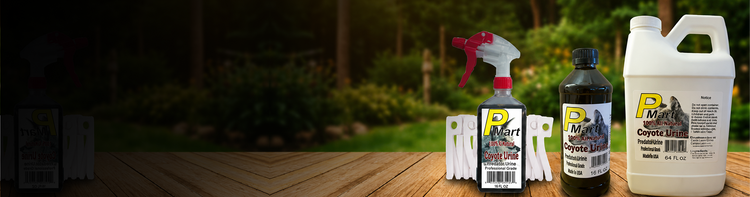
Protect Your Landscape with Wolf Urine Deer Repellent
Protect Your Landscape with Wolf Urine Deer Repellent
Deer don't need a gap in your fence or an unlocked gate to get into your garden. They follow scent trails, revisit spots where they found food before, and return night after night until there's nothing left to eat.
Wolf urine deer repellent works on a completely different level than sprays that taste bad or physical deterrents that deer learn to work around. It tells deer, through the one language they trust completely, that a predator has claimed this territory.
At The Pee Mart, our wolf urine is 100% genuine predator scent, and that authenticity is exactly what makes it effective where other approaches fall short.
How Deer Actually Process a Predator Scent Signal
Deer operate on a hierarchy of fear. When they encounter the scent of a wolf, they read it as a clear territorial signal from a primary natural predator and choose to avoid the area.
This differs from physical deterrents or plant sprays, which require deer to get close enough to taste or touch the treated area before the aversion kicks in. A perimeter scent barrier built with wolf urine stops the approach before deer get near your plants.
Wolf urine is especially well-suited for larger deer species and properties where elk and moose are also a concern. For whitetail deer, both coyote urine and wolf urine are effective, but wolf urine delivers a stronger apex-predator signal that is harder to dismiss over time.
Which Parts of Your Landscape Need Scent Barriers and Which Don't
Not every corner of your property needs equal coverage. Deer follow patterns, and smart placement is about putting your wolf urine deer repellent where those patterns intersect with the areas you're protecting. Before applying anything, take note of:
● Where deer have been entering your property: Look for hoof prints in soft ground, flattened grass at fence lines, or browse damage on lower shrubs and trees.
● Natural entry corridors: Wooded edges, creek crossings, hedgerow gaps, and any low-lying spots in fencing are the most common access points.
● Wind direction: The scent needs to travel toward approaching deer. Marking the downwind side of your garden means deer may be halfway across your lawn before they catch the warning. Always mark the windward side.
● High-value plantings: New perennial beds, vegetable gardens, fruit trees, and ornamental shrubs that deer have targeted before should be priority zones for your first line of scent markers.
Application Methods That Match How Deer Move Through Your Property

P-Wicks Along Garden Borders and Fence Lines
P-Wicks are a practical way to build a continuous scent line around a garden or landscape area. Saturate each wick with wolf urine deer repellent and hang one every 10 to 12 feet, no higher than 18 inches from the ground.
For gardens and ornamental beds, place the wick line just outside the planting area so deer encounter the scent before entering.
Granules for Broader Landscape Coverage
For wide lawns, open yards, or extensive shrub plantings, granules provide broader coverage. Scatter them along the outer edges of the space you're protecting, especially near wooded areas or fields where deer bed down.
Wolf urine is available in both liquid and granule formats, allowing you to match the application method to your property.
Trigger Spray for Targeted Spots
A trigger spray bottle works best on gate posts, fence corners, and the base of trees near planting areas.
Apply roughly half an ounce per spot and offset reapplication placement slightly each time to maintain the impression of a patrol instead of a fixed marker.
Use this table to match your landscape layout with the right application approach:
|
Landscape Zone |
Recommended Format |
Placement Notes |
|
Vegetable or flower garden |
P-Wicks with liquid wolf urine |
Every 10 to 12 ft, just outside the garden edge |
|
Wide lawn or open yard |
P-Cover granules |
Scatter along outer borders nearest tree lines |
|
Fence lines and gate posts |
Trigger spray or P-Wicks |
Focus on corners and low fence gaps |
|
Fruit trees and ornamental shrubs |
P-Wicks placed at tree drip line |
Circle the tree group at 10 to 12 ft spacing |
Why Deer Come Back Even After Your First Application and What to Do About It
Deer are creatures of habit, so they won't abandon a trail immediately. In the first few days, you may still see them approach, sniff the perimeter, and turn away. What matters is whether they're staying back or pushing through.
If deer are still breaching the line after a week, check your reapplication schedule and look for gaps in the wick line, especially after wind events. Wolf urine loses potency faster in heat and dry conditions, so a 10-day summer cycle may need to be shortened to 7 days.
For heavy deer pressure, consider running a second wick line a few feet inside the first to create a layered scent boundary before deer reach your plants.
To Wrap Up
Deer aren't going to stop looking for food in your yard on their own. But you can make your property consistently less worth the risk by giving them a clear, instinct-level signal to move on.
Wolf urine deer repellent does exactly that without chemicals, without harm to wildlife, and without the frustration of watching a deer casually ignore whatever you tried last season.
We help thousands of gardeners, homeowners, and landowners build natural scent barriers that actually hold. Check out our wolf urine options, pick the format that fits your property layout, and start protecting your landscape the natural way. Your plants will thank you!
FAQs
1. Does wolf urine work on all deer species, or just whitetail?
Wolf urine is effective across deer species. For whitetail deer, both coyote urine and wolf urine work as deterrents, but wolf urine delivers a stronger apex-predator signal.
2. Is wolf urine safe to use around vegetable gardens where I grow food?
Yes. Wolf urine is a 100% natural product that does not introduce chemicals into your soil or onto your plants.
3. How soon after applying wolf urine should I expect to see fewer deer?
Most property owners notice reduced deer activity within a few days of the initial application when placement is correct.
4. What is the difference between using liquid wolf urine and granules for deer?
Liquid wolf urine deer repellent with P-Wicks is best for precise perimeter lines around specific planting areas. Granules are better suited for broad landscape zones like open lawns or wide borders where running a wick line isn't practical.


