

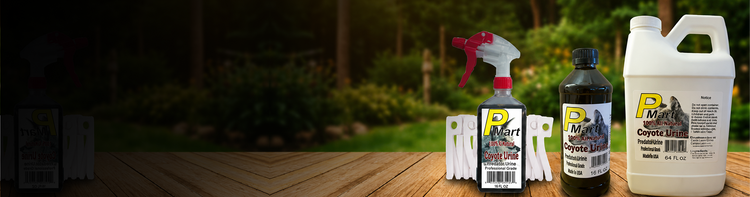
Best Natural Deer Repellent for Your Garden
Best Natural Deer Repellent for Your Garden
If deer keep treating your flower beds like a salad bar, you already know how fast a garden can go from thriving to stripped bare.
When you're searching for the best natural deer repellent, the answer isn't a single spray or a fence you rebuild every spring. It's a scent-based strategy that taps into a deer's oldest survival instinct, fear of predators.
At The Pee Mart, we have spent years helping gardeners protect their property with real, potent predator urine, and deer respond to it faster than almost any pest we deal with.
Why Deer Keep Coming Back to the Same Spot in Your Yard
Deer aren't wandering into your garden by accident. They memorize routes. Once a deer finds a reliable food source, it builds a mental map and returns daily, usually at dawn or dusk when your yard feels quiet.
A one-time spray or a single fence panel hardly ever solves this, because you're dealing with a creature that has already made your hostas part of its routine.
Breaking that pattern means convincing the deer that the "safe" path it memorized isn't safe anymore. Predator scent doesn't chase deer away physically. It rewrites the signal your yard sends out, turning a familiar buffet into territory that smells like danger.
Coyote Urine and Wolf Urine Work Together as the Best Natural Deer Repellent
Two scents consistently outperform the rest when deer are your main problem: coyote urine and wolf urine.
Coyotes are common predators deer encounter, so the scent alone triggers an avoidance response. Wolf urine goes a step further, since wolves sit even higher on the food chain, and deer treat the smell as a serious threat.
Using both isn't overkill; it's strategy. Deer are smart, and leaning on the same scent for weeks lets some test the boundary and learn nothing is there.
Rotate Scents to Stop Deer From Adjusting
● Use coyote urine as your everyday barrier around beds and fence lines.
● Bring in wolf urine every few weeks or during high-pressure seasons.
● Shift application spots slightly each time you reapply so the scent trail feels fresh.
This rotation mimics how real predator territories shift, which is why it works as a long-term and the best natural deer repellent, not a quick fix.
|
Repellent |
Best For |
Reapply Every |
Ideal Format |
|
Coyote Urine |
Deer pressure, gardens, orchards |
7 to 10 days |
Spray or granules |
|
Wolf Urine |
Heavy deer activity, larger properties, rural land |
7 to 10 days |
Liquid or P-Cover granules |
Ready to build that barrier? Explore our coyote urine collection for everyday protection.
Where You Place the Scent Matters More Than How Much You Use
Many homeowners assume more product means better results, but placement does more work than volume.
Deer approach from predictable entry points, the edge of a tree line, a gap in a hedge, or the lowest point in a fence, and soaking the middle of your garden while ignoring these entry points leaves the door wide open.
For the best results:
● Apply along the perimeter, not just around individual plants.
● Focus on entry points where deer trails meet your property line.
● Keep the application no higher than 18 inches off the ground, close to where a deer's nose travels.
● Use a P-Wick or piece of cloth in dry spots to extend scent life between reapplications.
Think of it as building an invisible fence made of smell, protecting the whole property rather than every leaf on its own.
Check out our wolf urine products for stronger and more effective deterrence.
Seasonal Deer Behavior That Changes What You Need to Do
Deer pressure isn't constant year-round. Late winter into early spring, food sources thin out, and deer grow bolder about entering yards they'd normally avoid. During the fall rut, bucks travel farther, bringing new deer through your property that haven't learned your scent barrier yet.
Your plan should flex with the seasons:
● Early spring: reapply more frequently since deer are hungrier and more persistent.
● Fall rut: refresh the outer edges of your property, since new deer may be passing through.
● Summer: With natural food plentiful, you can usually stretch reapplication a little longer.
Signs Your Repellent Strategy Is Working

You don't need to catch a deer in the act to know your barrier is holding. Watch for:
● Fewer new hoofprints near garden beds.
● Browsed plants stop showing fresh damage, even as older nibbling stays visible.
● Deer trails shift to the far edge of the property instead of cutting through the middle.
● Plants you once fenced off individually stay untouched.
If damage continues past two to three weeks, increase your reapplication frequency or add a second scent before switching products. That combination is what makes this the best natural deer repellent approach for the long run.
Protect Your Garden Before Deer Settle In
Deer damage rarely stays small. A few nibbled leaves can turn into stripped stems and ruined beds within a season, especially once a deer decides your yard is a safe stop.
You don't need chemicals, tall fencing, or constant patrolling to hold your ground. A consistent, well-placed application of coyote and wolf urine gives you a natural barrier that works with a deer's instincts, not against them.
Ready to protect your garden naturally? Shop our full range of predator urine at The Pee Mart and give your yard the protection it deserves.
Best Natural Deer Repellent FAQs
1. Does the best natural deer repellent work in every climate?
Predator urine works in most climates, but hot, dry areas hold scent longer while rainy regions need more frequent reapplication.
2. Can I use coyote or wolf urine near vegetable gardens?
Yes. Both are safe around the perimeter and won't harm your plants, soil, or the produce you're growing.
3. How long before I see results after applying deer repellent?
Most homeowners notice reduced browsing within days, though deterring an established feeding spot can take one to two weeks.
4. Do I need a fence for predator urine to work?
Not always, but pairing scent barriers with a low fence or motion lights adds extra protection.


