

Fact Check: Does Coyote Urine Repel Rats and Mice?
Fact Check: Does Coyote Urine Repel Rats and Mice?
If you have been researching natural rodent deterrents, you have almost certainly run into conflicting information. Some sources are confident that predator urine works on all rodents. Others dismiss it entirely. Neither position gives you the nuanced answer you actually need to make a useful decision.
So let us do a proper fact check: does coyote urine repel rats and mice, what does the science of predator scent recognition actually say, and what are the conditions under which it works versus when it falls short?
What the Predator Scent Response Actually Is
Before evaluating whether coyote urine works on rats and mice, it helps to understand predator scent response. Rodents have a highly developed chemosensory system that detects threat signals through both the main olfactory system and the vomeronasal organ.
Research shows compounds in canid and felid urine can trigger fear and avoidance in rodents. These reactions are instinctive, shaped by predator-prey evolution. Even rats or mice with no direct encounter with coyotes can still recognize coyote urine as a danger signal.
Where Does Coyote Urine Work and Where It Has Limits
Rats, particularly brown rats that have adapted to urban and suburban environments, are among the most behaviorally flexible rodents in the world. If you are wondering, does coyote urine repel rats? The answer depends on conditions and application.
Their neophobic tendencies, which means their natural wariness of new stimuli, are strong. But so is their motivation when food rewards are high.
The conditions under which coyote urine performs reliably against rats:
● Perimeter deterrence before rats establish a presence. When used preventively along boundary zones and near structural access points, coyote urine discourages rats from approaching and testing entry points.
● Rural and semi-rural settings. Rats with less urban conditioning respond more strongly to predator scent because their instinctive responses have not been dampened by constant exposure to human environments.
● When used as part of a layered system. Coyote urine combined with proper exclusion work and the removal of food attractants produces the most consistent results against rats.
Where it has limitations:
● Heavily urbanized rat populations. Rats in high-density urban environments have reduced fear responses across the board, including to predator scent. This does not mean coyote urine is ineffective, but it means expectations should be realistic, and application needs to be especially consistent.
● When food pressure is extreme. No deterrent, natural or chemical, overrides a rat's motivation when food is extremely abundant and accessible nearby. Reducing attractants is non-negotiable.
Coyote Urine vs. Bobcat Urine for Rats and Which Is the Stronger Choice
For rats and mice, bobcat urine is the stronger targeted deterrent because bobcats regularly prey on small rodents. The predator-scent relationship is more direct.
If you are asking, “Does coyote urine repel rats?" It can help, but coyote urine has a broader role and is used against rodents, raccoons, foxes, and deer.
|
Target Pest |
Coyote Urine Effectiveness |
Bobcat Urine Effectiveness |
|
Field mice (rural properties) |
Strong |
Very strong |
|
House mice (structural entry) |
Moderate to strong |
Very strong |
|
Brown rats (suburban) |
Moderate |
Strong |
|
Urban rats (high adaptation) |
Moderate |
Moderate to strong |
|
Voles and moles |
Moderate |
Very strong |
The Variables That Determine Whether Predator Urine Works in Your Situation

People who report that predator urine did not work for them almost always share one or more of the following conditions. Understanding these variables helps you avoid the same outcome.
Infrequent Reapplication
Scent degrades in outdoor conditions. A single application that is not refreshed for two or more weeks will fade to a level that no longer communicates an active predator presence. Consistent, scheduled reapplication is the single most important factor in sustained effectiveness.
Incorrect Placement
Treating only the most obvious entry holes while leaving travel corridors and perimeter zones unaddressed gives rodents multiple unguarded approaches. Coverage needs to be comprehensive.
Leaving Strong Food Attractants in Place
Coyote urine tells rodents there is danger nearby. But if there is a reliably accessible food source inside the deterrent perimeter, that competing signal can override the scent warning.
Using Synthetic or Diluted Product
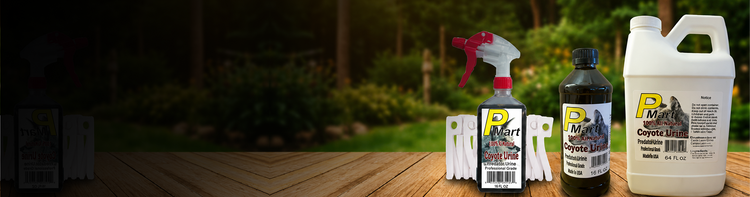
Not all products labeled as predator urine contain genuine, biologically active urine. The Pee Mart collects and supplies 100% real coyote urine to ensure the biological potency that makes the deterrent effect work.
Conclusion
Does coyote urine repel rats and mice? Yes, with the honest caveat that effectiveness depends on the type of rodents you are dealing with, the consistency of your application, and whether you are managing the environmental factors that attract rodents in the first place.
At The PMart, we have nearly 30 years of experience helping property owners figure out exactly these questions. Our genuine coyote urine, bobcat urine, and full range of predator scent products give you the options you need to build a deterrent system tailored to your actual situation.
Shop our rodent deterrent products today and get the right tool for your specific pest problem.
FAQs
1. How is coyote urine different from chemical rodent repellents sold at hardware stores?
Chemical repellents typically rely on irritants like capsaicin or naphthalene that rodents can habituate to. Coyote urine triggers a hardwired biological fear response rooted in predator recognition.
2. Can rats and mice become immune to coyote urine over time?
Habituation to genuine predator urine is far slower and less complete than habituation to synthetic or chemical deterrents because real urine contains complex biological compounds, not a single-note irritant.
3. Does coyote urine repel rats on the roofs as well as ground-level rats?
Roof rats are primarily aerial travelers, moving along fence tops, branches, and structural overhangs. Elevated dispenser placement at 18 to 24 inches, combined with ground-level granules, extends the scent into the zones where roof rats travel.
4. I have tried predator urine before, and it did not seem to work. What could have gone wrong?
The most common reasons are infrequent reapplication, incorrect placement, strong food attractants overriding the scent signal, or using a diluted or synthetic product that lacks biological potency.
5. Is there a risk that coyote urine will attract coyotes to my property?
No. Coyote urine functions as a territorial marker, not an attractant. Other coyotes reading the scent are more likely to avoid the marked zone as already claimed territory rather than move toward it.


