

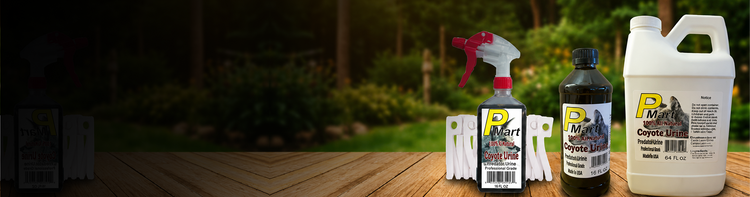
Keep Rodents Out with Coyote Urine for Mice
Keep Rodents Out with Coyote Urine for Mice
Most people reach for fox urine or bobcat urine when mice are the problem, and both are solid choices for small rodents. But there is a specific situation where coyote urine for mice outperforms those options, and it comes down to the kind of property you are protecting and the behavior pattern of the mice causing you problems.
If you are dealing with field mice migrating in from the surrounding landscape, traveling across open ground, or breaching a large property boundary, coyote urine brings a scent profile that operates at a fundamentally different scale and broadcast radius than smaller predator urines.
Why Coyote Urine and Fox Urine Are Not Interchangeable for Mice
Fox urine and coyote urine both create a predator scent signal that affects mice, but they do not function identically in the field. The difference lies in the territorial range and how far the scent-fear response radiates.
Foxes are relatively compact hunters with defined, modest territory ranges. Their scent triggers a localized response, which makes fox urine ideal for protecting specific structures, beds, or enclosed areas.
Coyotes, by contrast, are wide-ranging territorial animals that cover significantly larger areas. Their urine communicates a dominant predator presence that radiates over a broader zone. For properties where mice are approaching from open fields, tree lines, or large perimeter zones, coyote urine sends a signal that reaches and deters mice further out from the structure before they even get close enough to start testing entry points.
In practical terms, coyote urine for mice is the better choice when your mouse problem is less about a specific entry point and more about a broad wave of pressure coming from the surrounding landscape.
The Field Mouse Migration Problem That Most Homeowners Do Not Anticipate
Field mice, also called meadow voles or deer mice, depending on your region, do not typically originate on your property. They live in surrounding fields, meadows, brush lines, and wood edges, and they move toward structures as temperatures drop in late summer and early fall.
This migration can involve dozens or even hundreds of mice crossing an open boundary zone toward your home, barn, or outbuildings.
Treating individual entry points with a localized deterrent during a migration event is often insufficient because the pressure is coming from too wide a front. A coyote urine perimeter addresses this differently. When applied along the boundary line between the open terrain and your structures, it intercepts the migration wave with a scent that registers as a large, dominant predator occupying that transition zone. Mice that encounter it during migration are far more likely to reroute than to push through.
This is the scenario where coyote urine earns its place in the rodent deterrent toolkit rather than simply overlapping with fox urine or bobcat urine.
Properties Where Coyote Urine Is the Right Rodent Deterrent

Not every mouse problem calls for the same tool. Here is where coyote urine consistently outperforms smaller predator urines for rodent control.
● Rural properties and acreage.
● Barns and large outbuildings.
● Garages and detached structures with vehicle storage.
● Properties with active coyote populations nearby.
Applying Coyote Urine Specifically for Rodent Pressure
The application strategy for a broad rodent deterrent perimeter differs from spot-treatment approaches.
|
Application Scenario |
Product Form |
Placement Detail |
|
Field-to-structure transition zone |
Granules |
Continuous band along the full boundary, 6 to 10 inches wide |
|
Barn or large outbuilding perimeter |
Granules + liquid |
Granule perimeter plus liquid spray at every ground-level entry point |
|
Garage or detached structure |
Granules |
Full perimeter around the foundation with extra concentration at corners |
|
Woodpile or brush pile adjacent to the structure |
Liquid spray |
Around the base of the pile and the soil between the pile and the structure |
|
Vehicle storage area |
Liquid spray |
Around the tires and undercarriage zone, focusing on the entry corridors |
Why Coyote Urine for Mice Holds Its Ground Where Other Deterrents Fade
Mice are neophilic animals, meaning they are naturally drawn to investigate new stimuli in their environment. This trait is why traps, repellent devices, and most synthetic deterrents have a limited effective window. Mice investigate, identify the signal as non-threatening, and habituate to it.
Genuine predator urine carries a biological complexity that synthetic deterrents cannot replicate. 100% real coyote urine at The Pee Mart contains hormonal and pheromonal compounds that communicate specific, layered information.
It is not a single-note scent that can be dismissed after a few exposures. It reads as a living, active territorial presence, and that reading stays consistent over time as long as you maintain fresh applications on a regular schedule.
Wrapping Up
Coyote urine for mice is not a substitute for other rodent deterrents. It is the right tool for a specific and very common problem: large-scale perimeter pressure from field mice migrating toward your structures.
When the source of the problem is the open terrain surrounding your property rather than a single entry crack in your foundation, you need a scent that operates at the scale of that terrain. That is exactly what coyote urine delivers.
Buy our coyote urine products today from Pmart and build a perimeter that mice will not want to cross.
Coyote Urine for Mice FAQs
1. If I already use fox urine for mice around my home, is there any reason to switch to coyote urine?
If your mouse problem is isolated to specific structural entry points, fox urine handles that well. If you are dealing with broad seasonal migration from surrounding fields, coyote urine provides a wider-radius deterrent that is better suited to that scale of pressure.
2. Can I use coyote urine and fox urine together in the same deterrent system?
Yes. Using coyote urine along the outer perimeter boundary and fox urine closer to structural entry points layers two predator scent signals and provides comprehensive coverage from the field edge to the foundation.
3. Does coyote urine for mice also work on voles and other field rodents?
Yes. Field rodents that share territory with coyotes in the wild respond to coyote scent as a genuine predator threat, making it effective across a range of small ground-dwelling rodents.
4. How wide should the granule band be along a property boundary line?
A band 6 to 10 inches wide provides reliable coverage. At corners and gaps in fencing or natural barriers, widen the application to 12 inches and apply extra product to those pinch points.


